
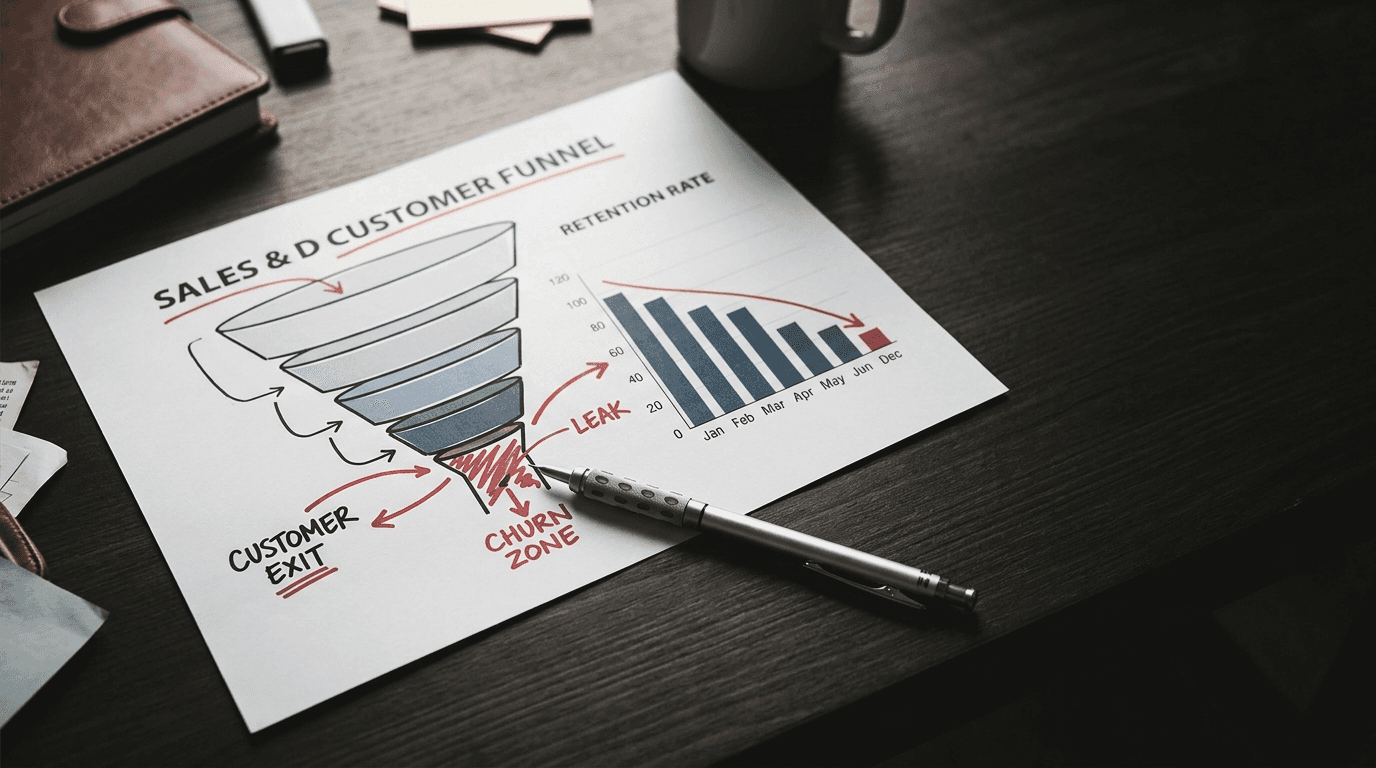
Learn how to measure and reduce churn in B2C sales through standardized processes, execution systems, and sales team training.
Why is controlling the abandonment rate in B2C sales crucial, and how can it impact a business's profitability? Controlling the abandonment rate (churn) allows for the identification of customer leaks and lost sales opportunities, optimizing resources and improving profitability. Effective churn management is key to sustainable growth and commercial efficiency.
Churn, or the abandonment rate, is one of the most decisive indicators for any B2C sales team. It reflects not only the loss of customers but also the sales opportunities that fail to materialize after investing in acquisition and qualification. This article addresses the essential concepts of churn, how to calculate it accurately, and practical strategies to reduce it, ranging from process standardization to the implementation of execution systems and continuous training. Everything is focused on maximizing conversion and business profitability.
What is churn and why does it matter in B2C sales?
Definition of churn
The abandonment rate, or churn rate, refers to the percentage of customers who stop buying, cancel a service, or do not complete the purchase process within a given period. In B2C sales, this encompasses both the loss of current customers and the desertion of potential customers after investing in their acquisition. It is a fundamental metric that assesses the health and stability of your customer base.
Impact on profitability
A high abandonment rate implies a direct loss of revenue and a significant increase in customer acquisition cost (CAC). This forces more resources to be allocated to keeping the customer base stable, decreasing the overall margin and profitability of the business. Consequently, the company is forced to constantly invest in new acquisitions to compensate for the losses.
Relationship with CLV and CAC
Churn directly affects customer lifetime value (CLV), which measures the total expected revenue per customer over the course of their relationship with the company. A high abandonment rate reduces CLV and increases CAC, hindering sustainable growth and long-term profitability. This relationship is fundamental to building a scalable business model.
How to calculate churn step by step?
Basic formula
Calculating your abandonment rate is simple. The formula is:
Abandonment rate (%) = (Customers lost during the period / Customers at the start of the period) × 100
This metric allows you to accurately quantify the percentage of customers leaving your business in a specific timeframe.
Practical example
If a company starts the quarter with 5,000 customers and loses 250 during that period, the abandonment rate is (250 / 5,000) × 100 = 5%. This result allows you to evaluate performance and compare it to industry standards.
Reference values and thresholds
Below is an indicative table to provide context based on the B2C sector:
Period | Acceptable rate | Worrying rate |
|---|---|---|
Monthly | 3%–5% | >10% |
Quarterly | 7%–12% | >20% |
Annual | 20%–30% | >40% |
These values help contextualize your performance and define realistic, achievable goals for your team.
What strategies reduce churn in B2C sales?
Process standardization
Defining a clear sales process, from acquisition to post-sales follow-up, is essential to guarantee consistency. Documenting each stage allows the team to know exactly what to do at any given moment, preventing improvisations and information loss that lead to customer abandonment.
Systems that ensure execution
Implementing systems that centralize potential customer information and automate reminders is essential. Prioritizing tools that guide sales staff at every step, rather than just recording data, ensures the strategy is executed correctly and the abandonment rate is reduced.
Training and post-sales follow-up
Continuously training the team in conversion techniques and handling objections significantly improves results. Conducting post-sales follow-ups to identify the causes of abandonment and improve the customer experience helps extract valuable lessons learned for future improvements.
Actionable checklist to reduce abandonment rate:
Standardize the sales process and document each stage clearly.
Use systems that ensure daily and consistent execution of the process.
Train the team in conversion, handling objections, and follow-up.
Regularly analyze the abandonment rate and segment by channel, product, and customer profile.
Implement retention programs and satisfaction surveys to identify opportunities for improvement.
How to scale a sales team without losing control?
Industrialization of sales
Standardizing processes allows each team member to know exactly what to do at every stage, preventing improvisations and information loss. This industrialization is key to maintaining quality as you HTML grow.
Metrics for scaling
Establishing key indicators such as abandonment rate, conversion rate, and post-sales follow-up, and reviewing them regularly, facilitates orderly growth. These metrics act as a compass to guide team expansion decisions.
Roles and responsibilities
Clearly defining the roles of sales staff, managers, and support is essential for maintaining quality and consistency when scaling. A clear structure prevents confusion and ensures each team member understands their contribution to the common goal.
Why does execution matter more than management?
Systems vs tools
Having tools to record data is not enough. It is crucial to have systems that ensure the sales process is executed consistently and the abandonment rate is reduced. The difference lies in the fact that systems guarantee compliance, while tools only record information.
How to ensure daily execution
Monitoring daily activity, automating reminders, and establishing clear routines helps the team follow the defined process. This operational discipline is what truly makes a difference between companies that succeed in reducing their churn and those that constantly struggle with customer desertion.
Transform your sales management and reduce your abandonment rate
Reducing the churn rate requires clear processes, robust execution systems, and continuous team training. The key is to ensure that every step of the sales process is executed consistently, from acquisition to post-sales follow-up. By implementing these strategies, your company will not only retain more customers but will also significantly improve its profitability and chances of sustainable growth.
Vixiees complements CRM functionalities by guaranteeing the execution of the defined sales process, providing real-time visibility into your team's activity and facilitating the necessary adjustments to reduce abandonment. Request a Strategic Meeting with Vixiees to review your sales process, identify leakage points, and design a customized action plan to transform your churn rate.
Expert Opinion: Managing the churn rate is much more than a metric; it is the X-ray of the commercial health of any B2C business. Rigorous monitoring of customer loss, along with standardized processes and execution systems, allows for the identification of critical points and swift action. The key lies in transforming data into concrete actions, empowering the team, and ensuring that every interaction with potential clients is executed according to the defined process. Only in this way can conversion be maximized and customer leakage reduced, directly impacting customer lifetime value and profitability.