Discover what the sales funnel is, how to identify leaks at each stage, measure conversions accurately, and execute strategies that scale your B2C team efficiently.
How can a B2C sales leader transform their sales funnel into an execution system that identifies leaks, optimizes conversions, and scales results sustainably? The answer lies in understanding each stage of the prospect journey, setting clear metrics, and moving from reactive management to disciplined, data-driven execution. Explore how to implement it step by step below.
The sales funnel is one of the most critical concepts for those who lead B2C teams. Understanding how this model works makes it possible to identify where prospects are lost, optimize marketing and sales investment, and focus strategy on measurable, scalable results. In this article, we'll explore in depth what the sales funnel is, what its key phases are, which metrics you should monitor, and, most importantly, how to transform traditional management into systematic execution to maximize conversions and growth.
What is the sales funnel and how does it work in B2C?
This section defines the sales funnel, its structure, and its direct impact on consumer sales.
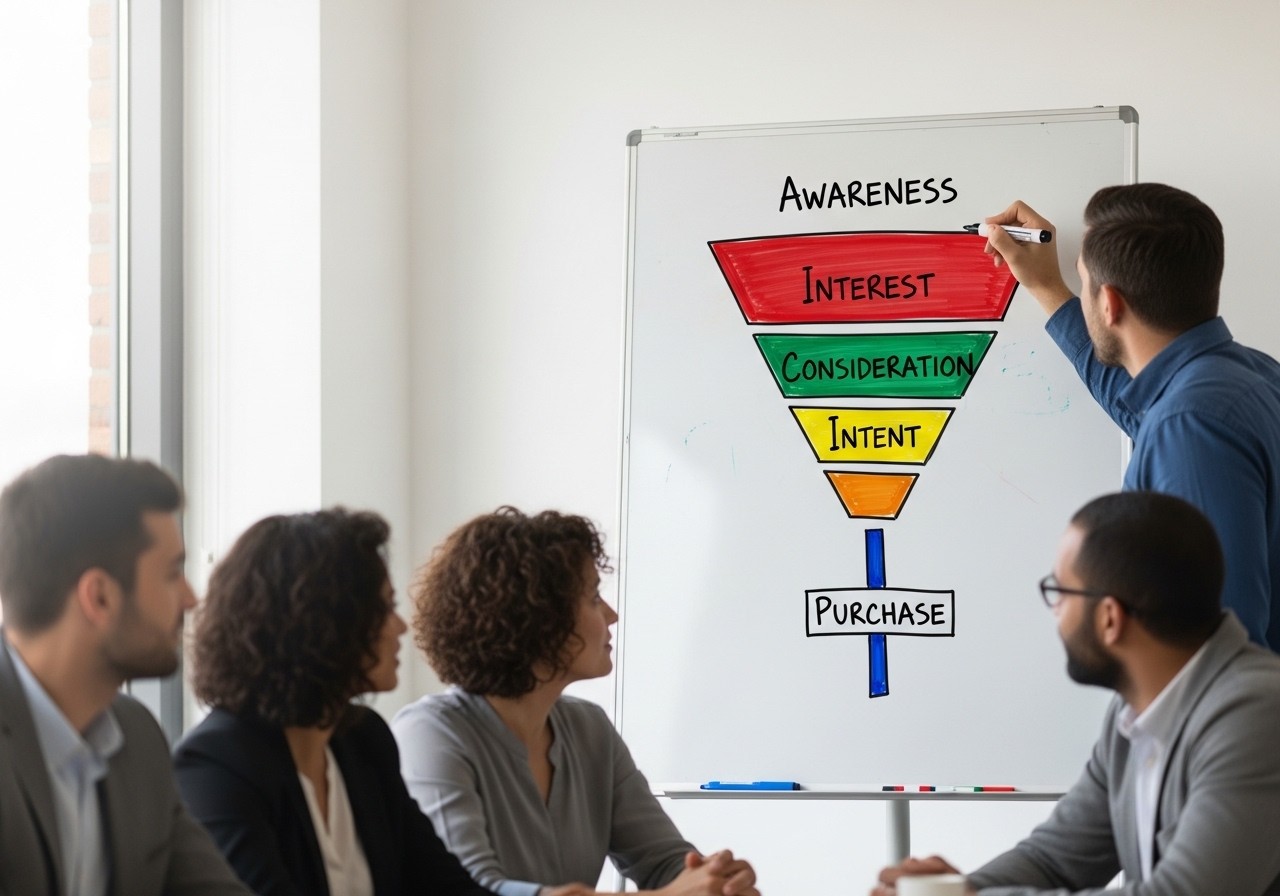
The sales funnel, also known as the sales pipeline, is a visual and strategic model that describes the complete journey of the prospect from first contact to purchase and, subsequently, loyalty. In the B2C context, where the speed and volume of transactions are critical, having clear, measurable, and systematic processes is essential to scale results.
An effective funnel not only visualizes the customer journey, but also establishes control points, performance metrics, and specific tactical actions for each stage. This allows sales leaders to quickly identify where bottlenecks are concentrated and where valuable opportunities are being lost.
What elements make up an effective sales funnel?
Although funnels can vary by industry and business model, they are generally made up of the following key elements:
Structured phases: Awareness, interest, consideration, decision, and loyalty. Each phase has clear objectives and requires specific actions.
Clear, measurable KPIs: Key performance indicators (KPIs) by stage, such as conversion rate, cost per lead, customer lifetime value, and return on investment.
Aligned tactical actions: Strategies adapted to each stage, from digital marketing campaigns to post-sale follow-up and loyalty programs.
Robust tracking systems: Tools that make it possible to record, analyze, and optimize the progress of each prospect through the funnel.
Team alignment: Marketing and sales must share objectives, data, and success criteria to ensure consistency in messaging and execution.
Review this week whether your conversion process includes all of these elements. If one is missing, you are probably losing opportunities and leaving money on the table.
What basic metrics should I know and monitor?
To make informed decisions, it is essential that you understand and track these key metrics:
Conversion rate by stage: (Customers converted / prospects in the stage) × 100. This metric tells you how effective each stage of the funnel is.
Cost per lead (CPL): Total marketing investment / number of leads generated. It helps you evaluate the efficiency of your ad spend.
Customer lifetime value (CLTV): Estimated revenue that a customer will generate throughout their entire relationship with the company. This metric is crucial for understanding long-term profitability.
Return on investment (ROI): (Revenue generated - investment) / investment × 100. Indicates the overall profitability of your sales and marketing efforts.
What are the stages of the sales funnel and what actions drive results?
We analyze each stage of the sales funnel, its objectives, critical metrics, and the tactical actions that generate conversions.
Stage | Main objective | Recommended KPIs | Key tactical actions | Suggested benchmark |
|---|---|---|---|---|
Awareness | Attract and capture attention | Impressions, reach, visitors | Marketing campaigns, social media content, SEO | 40-60% of total traffic |
Interest | Generate curiosity and capture information | Clicks, sign-ups, downloads | Ebooks, webinars, forms, educational content | 30-40% of visitors |
Consideration | Evaluate solutions and resolve objections | Response rate, scheduled demos | Personalized calls, segmented emails, case studies | 20-30% of sign-ups |
Decision | Close the sale | Close rate, revenue, average ticket | Limited offers, testimonials, guarantees, free trials | 10-20% of consideration |
Loyalty | Repeat purchases, retention, and referrals | NPS, repeat purchase, referral rate | Post-sale follow-up, loyalty programs, support | 60-80% of customers |
What characterizes the awareness stage and how can you maximize its impact?
In the awareness stage, the goal is to capture the attention of the prospect who does not yet know your brand or solution. During this stage, the focus should be on reach and visibility.
The most effective actions include digital marketing campaigns (SEM, display), relevant social media content, SEO strategies for organic ranking, and partnerships with influencers or specialized media outlets. It is essential to measure impressions, reach, and generated traffic in order to continuously adjust messaging and channels.
What actions work in the interest stage and how do you retain attention?
Here the prospect shows initial curiosity about your brand or product. The goal is to maintain their interest and obtain their contact details for future communications.
Offer high-value resources such as downloadable ebooks, educational webinars, free trials, or initial consultations. Create strategic forms that balance data capture with the user experience. Measure sign-ups, download rate, and time spent on landing pages to optimize the content.
How do you personalize in the consideration stage and differentiate your offer?
At this stage, the prospect actively compares your solutions with those of the competition. Personalization and response speed are critical differentiating factors.
Respond to specific objections with personalized information, demos tailored to their needs, relevant case studies, and direct contact with your sales team. Implement segmented emails based on user behavior and create content that directly addresses common questions. Measure response rate, scheduled demos, and response time to identify friction.
What elements should you close in the decision stage and how do you drive conversion?
The prospect is ready to buy. Your goal is to reinforce trust and eliminate final objections.
Use testimonials from satisfied customers, money-back guarantees, time-limited discounts, and clear value propositions. Make sure the purchase process is simple, secure, and frictionless. Measure close rate, average transaction value, and generated revenue. Continuously optimize based on these data.
What processes should be ensured after purchase and how can you maximize customer value?
Loyalty begins immediately after the sale. A satisfied customer not only makes repeat purchases, but also becomes an advocate for your brand.
Implement personalized post-sale follow-up, satisfaction surveys, loyalty programs with real benefits, and incentivized referral systems. Create memorable experiences that justify future purchases. A satisfied customer can multiply their long-term value through repeat purchases, a higher average ticket, and recommendations to others.
Where are prospects lost and how can you measure leaks in the funnel?
This section explores how to detect inefficiencies, quantify losses, and optimize each stage of the conversion process.
How do you calculate conversion rate by stage accurately?
Conversion rate is the most important indicator for understanding the health of your funnel. Here we show you how to calculate it:
Formula: Conversion rate by stage = (Prospects that move to the next stage / Prospects in the current stage) × 100
Practical example: If you have 500 sign-ups (interest stage) and 100 of them schedule a demo (consideration stage), your conversion rate from interest to consideration is (100/500) × 100 = 20%.
Perform this calculation for each stage transition. This will allow you to quickly identify where the problems are concentrated and where the most opportunities are being lost.
What signals and patterns indicate significant leaks in the funnel?
Some warning signs that indicate critical leaks include:
Sharp drops in conversion rates between consecutive stages (more than 20-30% variation).
Low response rate to follow-up actions (less than 10-15% in the consideration stage).
Prospects with no contact within 24 hours of sign-up (significantly increases loss).
Decrease in average purchase value or low repeat purchase rate (indicates dissatisfaction or lack of personalization).
Excessively long cycle time between stages (may indicate operational inefficiency).
Review the conversion rate by stage this week. Compare it with benchmarks in your industry and detect critical points where leaks are concentrated. These are your biggest opportunities for improvement.
How do you move from reactive management to systematic execution and scale results?
Here we address how to transform traditional management into a disciplined execution system that drives conversions and sustainable growth.
What systems structure execution and ensure compliance?
The difference between companies that grow and those that stagnate lies in systems. Effective execution requires:
Clear, standardized processes for each stage, where every team member knows exactly what to do, when, and how to do it.
Tools that enforce follow-up and log every action, eliminating discretion and ensuring consistency.
Smart automation of repetitive tasks (follow-up emails, reminders, segmentation) to free up sales time and reduce human error.
Real-time alerts that notify the team when a critical action is not completed within the expected time.
How do you industrialize processes without losing control and personalization?
Industrialization does not mean dehumanization. It is about creating consistency while maintaining relevance:
Standardize service and follow-up so that every prospect receives the same quality of treatment, regardless of who handles them.
Use indicators and alerts to detect deviations in real time. If a follow-up call is not made within 24 hours, the system should automatically alert.
Limit discretionary decision-making within the sales team. Execute according to the defined process; do not improvise. This increases predictability and reduces variability.
Personalize at scale using data segmentation and adaptable templates that maintain relevance without sacrificing efficiency.
Practical steps to increase conversion and scale your funnel
Implement these steps in sequential order to transform your funnel:
Audit your current pipeline: Map each stage, identify the tools you use, and measure real conversion rates by stage. Compare it with benchmarks in your industry.
Identify leaks and root cause: For each significant drop in conversion, investigate why it happens. Is it a lack of follow-up? Weak messaging? Product not aligned with expectations?
Define immediate corrective actions: Prioritize the interventions that will have the greatest impact. Often, improving response time by 50% can increase conversion by 10-20%.
Automate systematic follow-up: Implement tools that ensure every prospect is contacted at the right time, with the right message.
Personalize communication by segment: Use demographic, behavioral, and psychographic data to adapt messages without sacrificing scale.
Measure, analyze, and continuously optimize: Hold weekly meetings to review KPIs, identify deviations, and adjust tactics. Continuous improvement is systematic, not episodic.
Industrializing sales reduces operational friction, improves result predictability, and makes it possible to scale without losing control over quality and outcomes. Companies that master this approach grow 3-5 times faster than their competitors.
Systematic execution: the differentiator in B2C sales
The sales funnel is not just a theoretical concept; it is the system that separates leaders who scale results from those who get stuck in reactive management. Understanding each stage, measuring precisely, and executing with discipline are the pillars that transform prospects into sales and sales into lasting relationships.
To ensure that your sales strategies are implemented consistently and measurably, consider a strategic assessment with Vixiees. Vixiees is not a traditional CRM; it is the system that enforces the defined process, guarantees systematic follow-up, and provides you with the real-time visibility you need to scale your sales funnel without sacrificing control.
Expert opinion: The sales funnel is more than a theoretical diagram; it is the blueprint that allows sales leaders to anticipate where opportunities are lost, allocate resources intelligently, and scale revenue without sacrificing quality. In my experience, organizations that measure, analyze, and act on each stage of the funnel achieve sustained improvements in their KPIs, reduce operational friction, and create lasting competitive advantages. Success lies not in managing, but in executing with discipline, data, and systems that enforce compliance.