
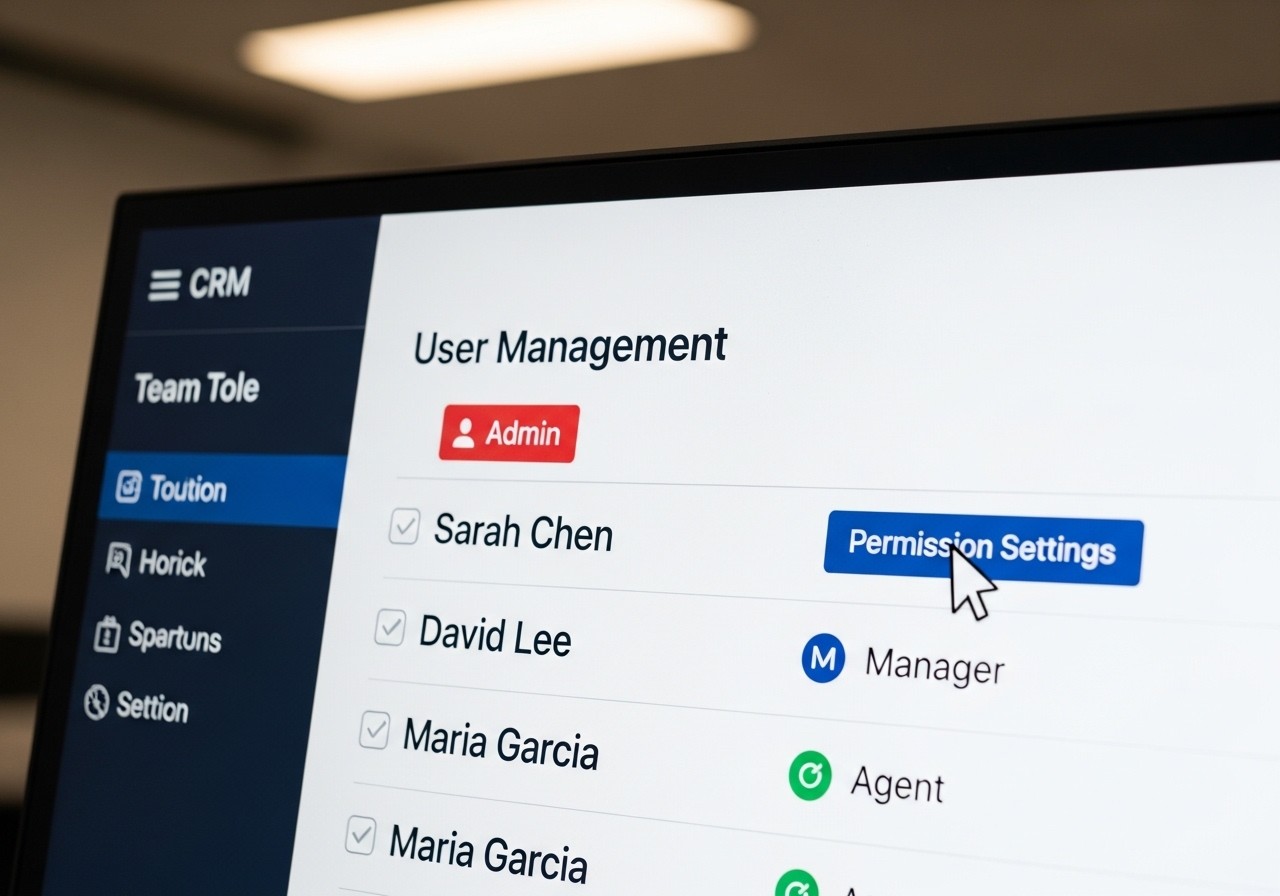
Discover how effective user management in CRM optimizes lead assignment, improves follow-up, and increases the conversion of potential customers into measurable sales.
How does user management in CRM impact the conversion of leads into actual sales?
Well-structured user administration in the CRM makes it possible to assign prospects efficiently, ensure follow-up without delays, and improve data quality. This translates directly into higher conversion and full control over the sales process. It is estimated that companies that respond within the first hour increase their conversion by up to 7% compared to those that take more than 24 hours.
User management in CRM has become a critical factor for high-volume B2C sales teams. It makes it possible to assign prospects automatically, control access granularly, and ensure that every opportunity is managed without delays or errors. In this content, we will explore how effective account and permission management directly impacts conversion, sales performance, and the scalability of your operation.
What user management in CRM is and why it is crucial
Definition and strategic scope
User management in CRM is not only about creating accounts and passwords. It is a structured plan that strategically defines who can access which information and features, aligning the system structure with conversion goals and day-to-day sales operations.
This management is based on principles such as Role-Based Access Control (RBAC), clear definition of responsibilities, and automation of lead assignment processes. In today’s sales environment, where response speed is decisive, effective user administration has become a key competitive differentiator.
Direct impact on conversion
A well-designed access control system makes it possible to assign prospects automatically and prevent them from going cold. According to Forrester, companies that respond within the first hour increase conversion by up to 7% compared to those that take more than 24 hours. This shows that execution speed, enabled by optimal user management, generates measurable results.
Roles, permissions, and hierarchical structure
Identity management covers the definition of specific roles (sales rep, supervisor, administrator), granular permission settings, and team hierarchy organization. This ensures that each user accesses only the information they need, responsibilities are clear, and sensitive information is protected.
What problems user management in CRM solves
Although sales operations can vary depending on the company and its objectives, user management typically solves the following challenges:
Data silos and inefficient workflows
Without proper user control, teams create information silos, duplicate efforts, and lose prospects. This slows response times and significantly reduces the conversion rate, representing losses of up to €50,000 per month in high-volume companies (source: Forrester).
Role-based access control (RBAC)
RBAC makes it possible to assign permissions according to each user’s specific function. This protects sensitive information, prevents unnecessary access to critical data, and preserves information integrity.
Automatic territory and prospect assignment
Centralized account administration makes it easier to automatically distribute prospects by geographic area, product, or channel, optimizing coverage, balancing workload, and improving follow-up.
Key features it should include
Role-based access control (RBAC) with granular detail
Permission management and visibility of specific modules
Automatic and intelligent lead assignment
Real-time monitoring of user activity
Transparent hierarchy and defined team structure
Complete audit logging and full traceability
Operational and commercial benefits
Greater data security and regulatory compliance
Significant increase in sales efficiency
Reduction in duplicates, errors, and delays
Substantial improvement in information quality and consistency
Clear traceability and defined accountability
Scalable operations without loss of control
Comparison of access control approaches
Approach | What it controls | Operational advantage | When to implement it |
|---|---|---|---|
RBAC (Role-Based Control) | Functions and modules | Easy to manage, secure | Large teams with clear hierarchies |
ACL (Access Control Lists) | Users and specific fields | High customization and detail | Need for advanced granularity |
Automatic lead distribution | Intelligent assignment | Speed, fairness, and scalability | High volume of inbound leads |
How to implement user management in high-volume B2C sales
To effectively implement a user management strategy, it is necessary to follow a structured approach that combines technical configuration, automation, and continuous oversight.
Rules for automatic lead distribution
This process requires five key steps:
Define clear distribution criteria (geographic area, product, channel, lead value).
Configure specific rules in the CRM based on the defined criteria.
Run controlled pilot tests with small user groups.
Adjust rules dynamically based on results and operational feedback.
Establish governance owners and periodic review.
Automation of contact sequences and reminders
Standardizing sequences speeds up conversion and reduces improvisation. Example of a recommended sequence:
First automatic email: 1 hour after the lead enters
Automatic reminder to the sales rep: 24 hours
Scheduled phone call: 48 hours
Second personalized email: 72 hours
Close, reassignment, or escalation: 7 days
Dashboards, monitoring, and results analysis
Monitoring through dashboards makes it possible to identify bottlenecks, measure actual performance, and adjust quickly. Key KPIs to track:
Average time to first response
Conversion rate by lead source
Percentage of leads without follow-up after 48 hours
Average conversion cycle from assignment to close
Data accuracy (percentage of fields completed correctly)
Definition of roles, permissions, and hierarchical structure
The minimum recommended structure for high-volume operations is:
CRM Administrator: global configuration, access control, and governance
Data Owner: information quality, consistency, and validation
Quality Auditor: periodic review of processes and compliance
Team Supervisors: operational follow-up and team motivation
Sales Reps: execution of sequences and closing opportunities
Minimum requirements for sustainable governance
Document and communicate all defined roles
Assign specific owners for each critical area
Establish periodic reviews of access and permissions
Implement regular data quality audits
Common objections and how to address them
Cost versus return on investment (ROI)
Practical ROI assessment with these indicators:
Reduction in the sales cycle: from 90 to 60 days on average (source: Kylas.io)
Increase in conversion: real cases report increases from 5% to 10%
Savings from reducing uncontacted leads: avoided losses of up to €50,000 per month in high-volume companies (source: Forrester)
Resistance to change: practical steps to overcome it
Adopting new systems requires a strategic approach:
Provide role-specific training tailored to each role
Launch controlled pilots before full implementation
Identify and train "champion" users who lead adoption
Continuously measure adoption and communicate early results
Celebrate and publicly communicate initial wins
Improving data quality
Centralized account administration and automatic validation settings make it possible to move from 70% to 95% data accuracy (benchmark: EspoCRM). This makes strategic decision-making easier, reduces segmentation errors, and improves the customer experience.
How to prioritize execution over mere management
From systems that record to systems that execute
The key difference lies in transforming a CRM that only stores data into a platform that executes processes, automates contact sequences, and continuously generates measurable results.
Standardization of sales processes
Standardizing contact sequences, tasks, and reminders reduces improvisation, speeds up conversion, and improves consistency. Companies with clear and documented sales processes report annual revenue growth of more than 10% (Forrester).
Scaling without losing visibility or control
A centralized and well-structured user control system makes it possible to scale sales teams without losing visibility into operations, response capacity, or execution quality.
Immediate action plan (30–90 days)
To begin your user management transformation, follow these priority actions:
Define and document key roles and permissions (responsible: CRM administrator) — Weeks 1-2
Configure automatic lead assignment rules (responsible: data owner) — Weeks 2-3
Launch a pilot with weekly follow-up (responsible: team supervisor) — Weeks 3-6
Measure conversion and response-time KPIs (responsible: quality auditor) — Weeks 4-8
Review and adjust processes based on results (responsible: sales leadership) — Weeks 8-12
From management to execution: turn every lead into a sale
Effective user administration in CRM not only protects data and sensitive information, but also drives measurable and sustainable results. The key is to prioritize execution, process standardization, and continuous measurement to transform lead conversion into actual sales.
By implementing these user management strategies, your CRM will go from being a simple data repository to becoming a commercial execution machine. The benefits include shorter sales cycles, higher conversion rates, and more productive teams.
At Vixiees, we understand that every company has unique challenges in sales management. We invite you to schedule a strategic meeting to discover how we can take the execution and optimization of your CRM to the next level, ensuring that every prospect receives the attention they deserve at the right moment.
Expert opinion:
User management in a CRM goes far beyond creating accounts and passwords. It is the fundamental pillar that makes it possible to control access, clearly define responsibilities, and ensure that each prospect receives the appropriate attention at the right time. When implemented strategically, it not only minimizes errors and information leaks, but also significantly speeds up the sales cycle and increases conversion. Ignoring this aspect means losing valuable opportunities. In large, high-volume teams, identity and permission management is the difference between a chaotic process and an efficient sales machine.