
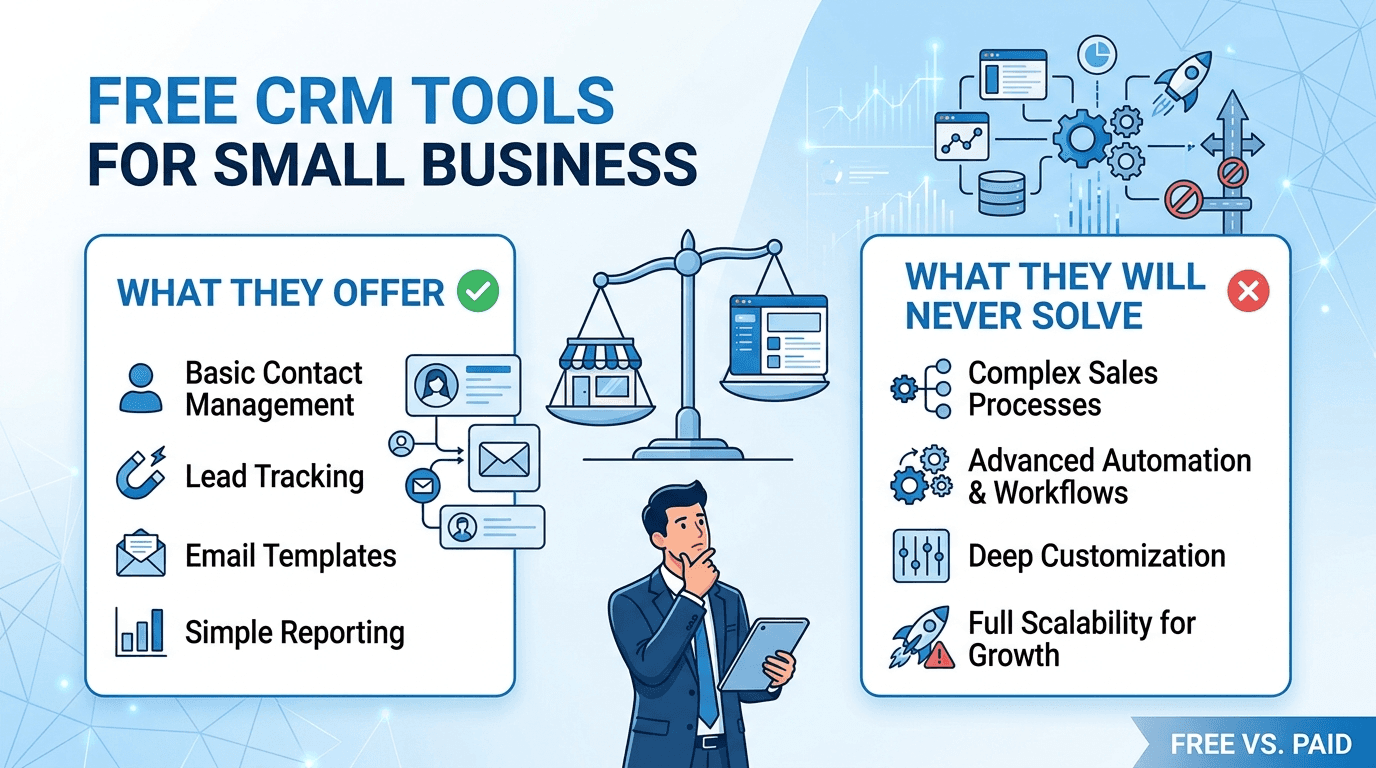
Practical analysis of free CRMs for SMEs in Spain and LatAm: what they offer, what they limit, and when it is advisable to switch to a paid solution.
How far can free CRMs help B2C SMBs, and when do they stop being enough? Free CRMs allow you to centralize contacts and improve initial organization, but they have clear limits in automation, scalability, and customization. Knowing how to identify that tipping point is key to avoiding loss of revenue and opportunities.
Free CRMs (free customer relationship management) have become the entry-level option for B2C SMBs looking to organize customer and lead management. In this analysis, we break down what these platforms actually deliver, their limits in automation and scalability, and when it is advisable to consider transitioning to paid systems. We explore key metrics, real scenarios, and practical recommendations for sales teams looking to optimize their conversion and profitability.
How do free CRMs help centralize contacts and visualize the pipeline?
A free CRM is a platform that allows companies to organize and manage customer and prospect information in a single centralized system. Its main strength lies in the ability to visualize the sales funnel and ensure that no contact is lost in the process.
Key benefits driving centralization
Centralization of contacts and potential customers in a single accessible repository.
Automatic logging of interaction history in an integrated system.
Clear and real-time visualization of the sales funnel by stages.
Key limitations to consider
Data quality and updates depend directly on disciplined adoption by the team.
Without clear processes and training, information quickly becomes obsolete.
Lack of advanced analytics and custom reporting to make strategic decisions.
Critical metrics to evaluate impact
Total number of contacts managed and segmented in the system.
Real-time visibility of the sales funnel and its evolution.
Typical scenario: transformation from scattered data
A sales team operating with disorganized spreadsheets manages to go from 40% of leads with no clear follow-up to 90% with an assigned owner after adopting a free CRM. This change is reflected in greater control and fewer lost opportunities.
Do free CRMs actually improve conversion?
Converting leads into sales depends on multiple factors, but speed and consistency in follow-up are decisive. Free CRMs offer basic tools that significantly improve these aspects when implemented correctly.
Key conversion benefits
Structured tracking of tasks and potential clients with assigned team members.
Scheduling automatic reminders and clear assignment of responsibilities.
Significant reduction in initial response time when contacting leads.
Key limitations affecting advanced results
Advanced automation and message personalization restricted or unavailable.
Limited scalability to run coordinated multi-channel campaigns.
Critical metrics to measure improvement
Time to respond to potential customers (Lead Response Time).
Effective contact and first-response rate.
Typical scenario: reduction in time and improvement in conversion
A company centralizes leads from its website and reduces response time from 2 hours to 15 minutes using automatic assignment. This simple change improves initial conversion by 35%.
What limitations do WhatsApp integrations have in free CRMs?
WhatsApp has become a critical channel for business communication. However, integrations in free CRMs have significant restrictions that affect both customer experience and operational efficiency.
Key benefits of basic integration
Centralized management of conversations started via WhatsApp from the CRM.
Simple message automation and smart chat assignment to agents.
Key limitations in functionality
No advanced multi-agent inboxes or deep integration with the WhatsApp Business API.
Limited scalability for large teams or high volumes of conversations.
Critical metrics to evaluate performance
Volume of interactions managed through WhatsApp.
Inquiry resolution rate and customer satisfaction.
Typical scenario: automation driving conversion
An online training platform automates course reminders and answers to frequently asked questions through integration of WhatsApp with its free CRM. The result is a 45% increase in conversion over 8 months with less manual effort.
Why might free CRMs not scale with your business?
As a business grows, its needs evolve faster than the capabilities of a free solution. It is essential to understand when a free CRM becomes an obstacle to growth.
Key benefits in early stages
They allow testing of essential features without significant initial investment.
They are suitable for small teams and early stages of business growth.
Key limitations hindering growth
Strict limits on the number of users, storage, and available automations.
Advanced customization and detailed reporting only available in paid versions.
Critical metrics to identify the scaling point
Number of active users needing simultaneous access to the system.
Volume of stored data and rate of growth of the contact database.
Emerging need for advanced features and specific integrations.
Typical scenario: the moment of growth
A travel services company grows from 3 to 10 agents and its contact database increases from 2,000 to 15,000 records. The free CRM system becomes insufficient to segment campaigns, automate workflows, and maintain service quality, hindering potential growth.
How does inefficient follow-up impact revenue and lead management?
The opportunity cost of poor follow-up is one of the largest revenue drains in companies without professionalized systems. Quantifying this impact is fundamental to justify implementing CRM solutions.
Key benefits of structured tracking
Systematic registration and assignment of leads to avoid oversights.
Clear structuring of the tracking process with defined stages.
Key limitations without discipline and automation
Without defined processes, leads are lost, forgotten, or go cold without contact.
High, recurring opportunity cost from leads not contacted or followed up on too late.
Critical metrics to evaluate lost revenue
Conversion rate from leads to actual customers.
Percentage of leads never contacted or abandoned.
Duration of the sales cycle from first contact to close.
Comparison table: impact before and after implementing a free CRM
Metric | Before free CRM | After free CRM |
|---|---|---|
Leads without follow-up (%) | 40% | 10% |
Response time (minutes) | 120 | 15 |
Lead-to-sales conversion (%) | 8% | 15% |
Typical scenario: quantifying losses
A company loses a significant amount of monthly revenue by failing to contact a large portion of its leads in a timely manner. Another, due to follow-up delays, fails to close several sales each month. These figures demonstrate the urgency of professionalizing management.
What is the ROI of implementing a CRM and execution system?
The return on investment in CRM depends on the company's ability to transform the tool into real processes and commercial discipline. A CRM without execution is just a data organizer.
Key benefits in measurement and professionalization
Clear and objective measurement of sales performance and commercial efficiency.
First strategic step to professionalize client and lead management.
Key limitations affecting actual ROI
ROI depends directly on clear processes, continuous training, and effective automation.
A free CRM without a defined execution system can scatter efforts instead of focusing them.
Critical metrics to measure return
Return on sales investment (ROI) expressed as a percentage or multiple.
CRM adoption rate by the sales team.
Typical scenario: evolution toward professionalization
A company that transitions from a free CRM to a paid solution, accompanied by defined processes and team training, reduces the sales cycle by 38% and increases sales by 54% in one year, demonstrating that system and discipline are just as important as the tool.
What objections do CEOs and sales directors raise about CRMs?
Resistance to change is natural. Here we address the most common objections and debunk the myths surrounding them.
"It is too expensive / We have no budget": The initial cost of a tool is visible and tangible, but the opportunity cost of not professionalizing management is recurring, silent, and much higher in the long run.
"We don't have the time or resources to implement it": The learning curve exists and requires an initial investment, but the loss of efficiency caused by not adopting a system is permanent and affects every transaction.
"Our current system is good enough": Informal methods work up to a certain point of growth; with expansion, visibility, control, and opportunities are lost.
"I don't know if it will work for my business": The adaptability of a CRM depends on defining clear processes, measuring results consistently, and continuously adjusting, not just on the technical capabilities of the tool.
What do success and failure cases with free CRMs teach us?
Real cases reveal clear patterns of what determines success or failure in CRM implementation.
Case 1 (success): A training center centralizes prospect inquiries and automates frequent answers using a free CRM. The result: a 180% increase in enrollments in 8 months due to better follow-up and fast response.
Case 2 (success): A premium real-estate company digitizes its sales funnel, reduces lost opportunities by 30%, and improves conversion by 25% by having clear visibility of each property being tracked.
Case 3 (failure): A service company fails to adapt the free CRM to its complex business flows and returns to manual methods, losing track of active follow-ups and leaving opportunities unclosed.
Why does a system outperform a tool alone?
This is the most important lesson: the tool is only 30% of success; the system is the remaining 70%.
A CRM without defined processes, continuous training, and a disciplined sales culture only organizes data; it does not generate results.
A clear strategy, a structured sales guide, execution discipline, and rigorous follow-up are what truly make the difference in conversion and sustainable growth.
How do you execute a scalable sales process with a CRM?
Effective implementation require a systematic approach that goes beyond simply activating the tool.
Define clear processes and specific roles within the team to avoid duplication and gaps.
Continuously train the team on CRM usage and strategic customer management.
Regularly measure and adjust based on key metrics to optimize results.
Scale the team without losing control over follow-up quality and execution consistency.
Evolve your commercial management: take the next step with a professionalized system
Free CRMs are a valuable entry-level solution for B2C SMBs seeking initial organization and visibility in their pipeline. However, they have a clear ceiling in automation, scalability, and customization capacity. If your goal is to increase conversion, improve operational control, and prepare your company for growth, the next step is to professionalize your sales system with defined processes, continuous training, and tools that adapt to your commercial complexity.
At Vixiees, we understand that commercial transformation is not just about technology, but about creating systems that work. We help you transform contact management into real results, aligning processes, training, and tools to maximize conversion and profitability. Request a Strategic Meeting to discover how to optimize your sales team with Vixiees, professionalize your pipeline, and scale your business without losing control.
Expert Opinion: Free CRMs are a valuable starting tool for SMBs looking to professionalize their customer management without an initial investment. However, the true leap in conversion and control only occurs when implementing an integrated management system, with clear processes, automation, and continuous training. The key is not to confuse tool with system: a free CRM can organize, but only a structured and scalable approach guarantees sustained results and real ROI. Periodically evaluating limitations and measuring the impact on critical metrics is essential to deciding when to evolve to a more robust solution.