
Analyze what free CRM software offers in B2C, the costs of not implementing a CRM, and how to improve conversion through processes and execution.
What real impact does a free CRM software have on B2C team conversion and management? A free CRM software can centralize data and optimize processes, but its limitations can affect conversion and growth. Analyzing its advantages and hidden costs is key to making informed and profitable decisions.
Free CRM software is an increasingly popular option among B2C (business-to-consumer) companies looking to organize and centralize lead management at no initial cost. However, choosing a free CRM solution involves analyzing both its advantages and its limitations.
Throughout this article, we explore how these platforms can solve common sales problems, the risks of poor execution, and what sacrifices it entails compared to paid options. Additionally, we provide practical steps, key metrics, and recommendations to maximize the performance of your sales team.
What is a free CRM software and how does it work?
A free CRM (customer relationship management) is an integrated system that centralizes all information about prospects and customers, allowing you to visualize the entire journey from initial contact to post-sales. This tool goes beyond a simple digital calendar: it is a structured plan that uses recording, tracking, and organization capabilities to achieve commercial goals such as increasing conversion, improving the customer experience, and preventing the loss of critical information.
In today's sales environment, CRM systems have evolved significantly thanks to basic automation, integrations with communication channels, and key metrics analysis. This allows sales teams to make decisions based on data rather than intuition.
What an effective free CRM software contains
Although implementations can vary depending on the company and its goals, a free CRM generally consists of the following elements:
Centralization of customer and prospect data. Consolidate all information in one place, avoiding fragmentation in spreadsheets or scattered applications. This involves recording demographic characteristics, interaction history, communication preferences, and stages in the sales funnel.
Sales funnel optimization. Identify which stage of the funnel each prospect is in, facilitating the prioritization of actions and the adjustment of strategies to increase the conversion rate. The CRM platform helps visualize the complete customer journey.
Key performance indicators (KPIs). Monitor metrics such as conversion rate, sales cycle, acquisition cost, and number of follow-ups per prospect. These metrics are evaluated to identify bottlenecks and opportunities for improvement.
Automation of repetitive tasks. Implement follow-up reminders, automatic status updates, and notifications. This frees up salespeople's time and reduces manual errors.
Integration with communication channels. In digital markets, integration with WhatsApp Business is fundamental. A free CRM solution with this capability allows you to unify communication and improve the traceability of each interaction.
Monitoring and analysis of results. Implement tracking tools to measure the performance of actions. Key metrics are evaluated, adjustments are made if necessary, and lessons learned are extracted for future improvements.
Continuous optimization. Make adjustments based on the data obtained. The goal is to maximize system performance over time, in relation to changes in the market and the needs of your team.
What common problems can a free CRM solve?
A free CRM software plays a fundamental role in the success of sales teams facing common operational challenges:
Data fragmentation. Many teams manage prospects in spreadsheets or scattered applications, which leads to duplication, lost info, and lack of visibility. A free CRM system centralizes information, improving accuracy and traceability.
Lack of systematic follow-up. Statistics show that most sales require multiple contacts, but many salespeople give up after the first one. A CRM automates reminders and records every interaction, ensuring that no prospect is lost due to a lack of follow-up.
Calculating the cost of inaction. Every lead without follow-up is a lost sale. For example: if you have a volume of prospects X with a conversion rate of 5% and an average sale value of Y euros, each uncontacted prospect represents unrealized revenue. A CRM allows you to quantify this impact and make data-driven decisions.
Lack of funnel visibility. Without a centralized system, it is difficult to know how many prospects are in each stage, what the average sales cycle is, or where the bottlenecks are. A free CRM provides this critical visibility.
How to successfully implement a free CRM in your team?
Although strategies can vary by company, the effective implementation of a free CRM requires the following steps:
Mapping current sales processes. Understanding your real operations is the first step. Document each stage of the funnel, lead qualification criteria, and the responsibilities of each team member.
Definition of key KPIs to monitor. Establish clear and measurable goals that align with your company's mission. These should be built in a SMART way (specific, measurable, achievable, relevant, and time-bound).
Selection of necessary integrations. Identify the most appropriate digital channels to reach your target audience. This can include WhatsApp Business, email, social networks, or web forms. Define the specific tactics to implement in each channel.
CRM system customization. The program must adapt to the actual operations of the team, not the other way around. Forcing unnecessary changes reduces adoption and effectiveness. Leverage customization to reflect your company's own sales structure and cycles.
Team training. Practical training, with clear scripts and visible KPIs, is essential to ensure adoption and disciplined use of the system. Develop a plan for relevant content creation including guides, tutorials, and training sessions.
Measurement of results and iterative adjustments. Implement tracking and analysis tools to measure performance. Key metrics are evaluated, adjustments are made if necessary, and lessons learned are extracted for future improvements.
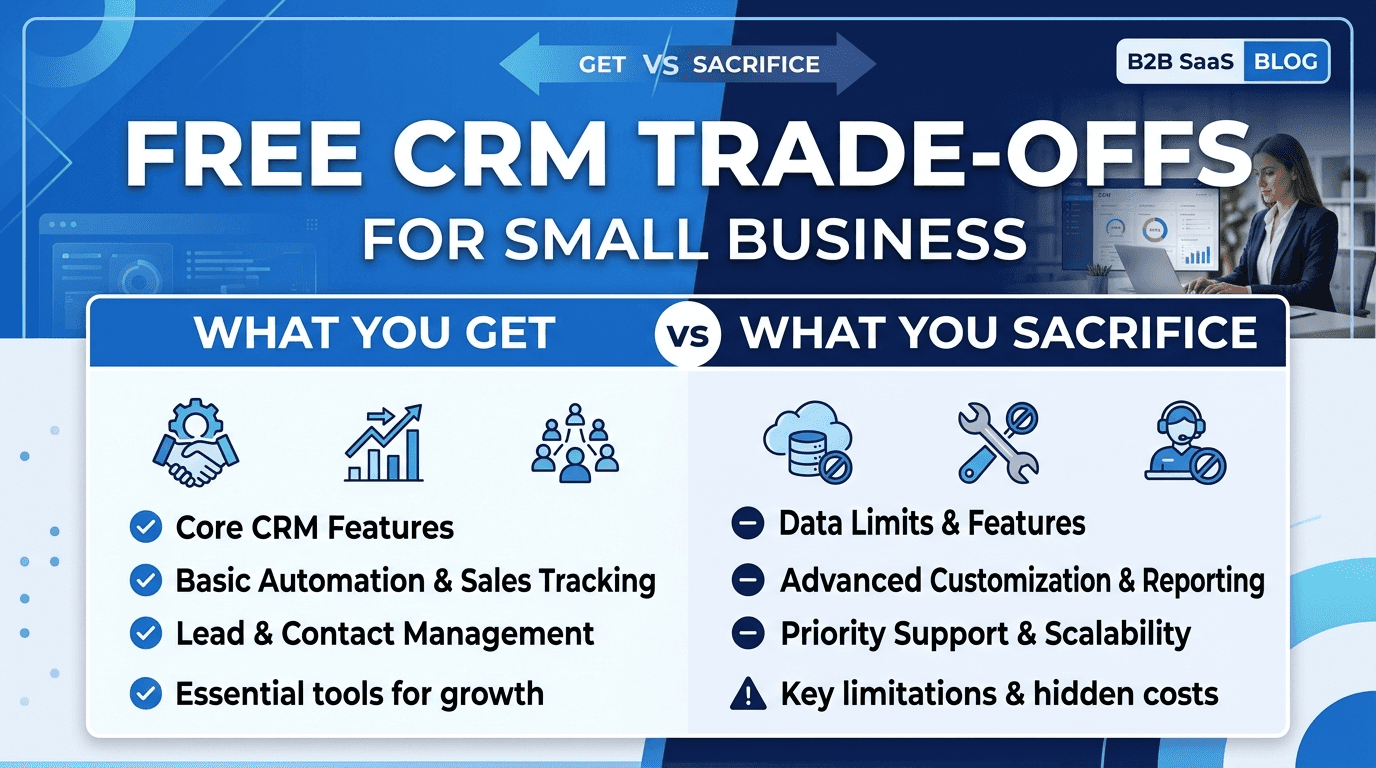
What are the sacrifices when choosing a free CRM versus a paid one?
Although the main advantage of the free CRM is financial savings, there are important limitations that you must consider as your business grows:
Area | Free CRM | Paid CRM |
|---|---|---|
Features | Basic (recording, tracking) | Advanced (automation, reporting) |
Support | Limited (forums, FAQs) | Personalized and fast |
Scalability | Limited users/contacts | No limits, flexible growth |
Integrations | Few or superficial | Deep and native integrations |
Operational Risk | Higher (failures, less backup) | Lower, guaranteed support |
A free CRM can fall short on advanced automation, deep customization, and support as your business grows. However, for teams in early stages, it can be a perfectly valid solution.
Why is execution more important than the tool?
The real value is not in the CRM platform itself, but in how it is integrated and executed within commercial processes. A well-implemented execution strategy defines what to do at each stage, who is responsible, and how results are measured.
Systems over tools. Standardizing and systematizing processes allows teams to scale without losing control or quality. Thus, each salesperson acts under the same criteria and metrics, reducing variability and improving predictability.
Clear roles and responsibilities. Success depends on salespeople executing the defined process, not improvising. Decision-making must be based on clear data and flows, not on intuition. This strengthens operational discipline and consistency in results.
Visible and accessible metrics. Teams that have constant visibility of their KPIs make faster and more effective decisions. This improves motivation, healthy competition, and results orientation.
Recommended KPIs and metrics to monitor
Review these indicators periodically to identify areas for improvement and justify technology investments:
Prospect-to-customer conversion rate
Average sales cycle
Customer Acquisition Cost (CAC)
Leads by acquisition channel
Average initial contact time
Number of follow-ups per prospect
Customer Lifetime Value (LTV)
CRM adoption rate
Contacted prospects vs. uncontacted prospects
Potential revenue lost due to lack of follow-up
Opting for a free CRM software can be useful as a first step to professionalize customer management, but the key lies in disciplined execution and adaptation to your actual processes. With the right strategies, even a no-cost solution can generate significant results.
If you are looking to maximize conversion and transform the execution of your sales team, schedule a strategic meeting with Vixiees and discover how our platform can help you implement an effective CRM system, automate critical processes, and position your brand as an authority in your category.
Expert Opinion: The adoption of a free CRM software in B2C (business-to-consumer) environments can be a strategic first step for teams seeking organization and quick visibility. However, the key lies in adapting the tool to actual business processes, not the other way around. The lack of customization, support, and scalability can hinder growth if future needs are not evaluated. The real difference is made by execution: clear processes, reliable data, and disciplined follow-up. A CRM, whether free or paid, only adds value if it is integrated into the operational culture and its impact on conversion and profitability is measured.