
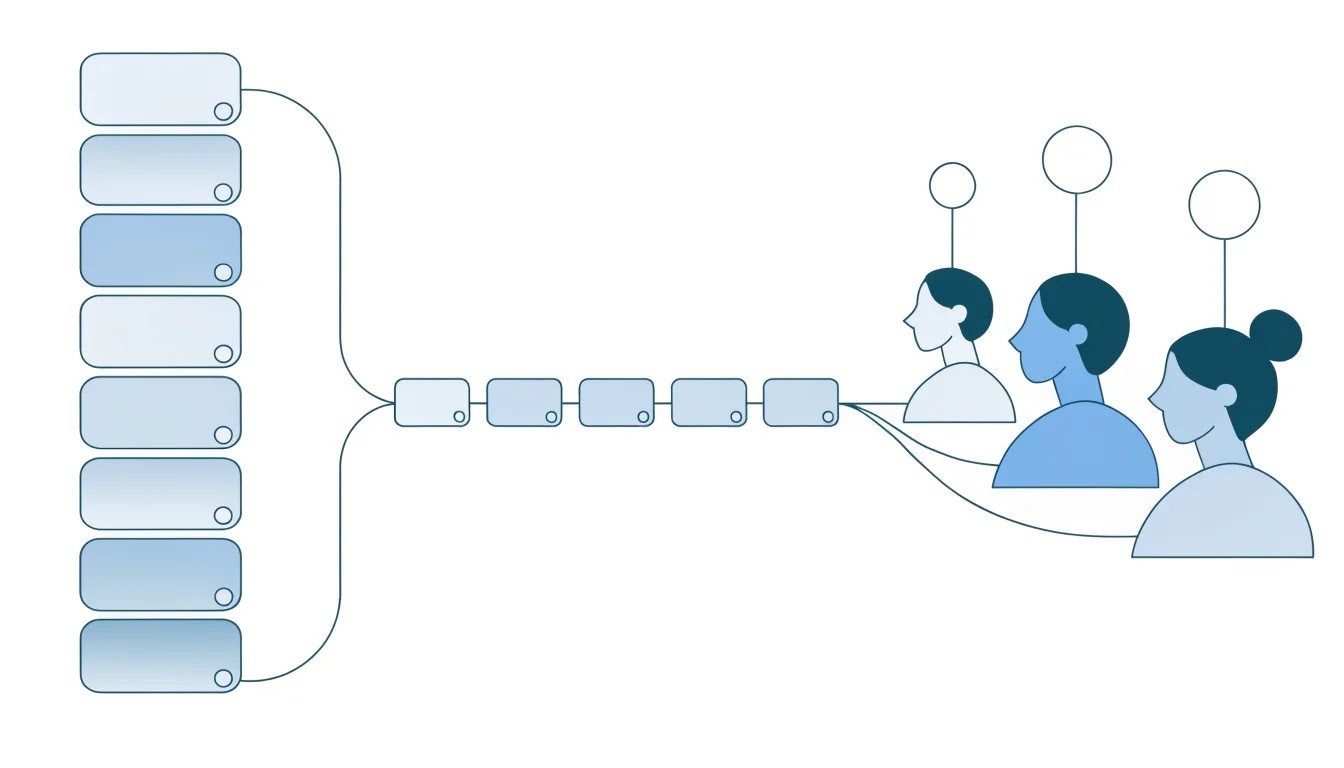
Why the daily organization of a sales team breaks down as it grows and how to avoid it, featuring the real case of Mundimoto and their documented results.
Why does a sales team's daily organization break down as it grows? Because lead distribution and coverage for absences could no longer be done manually. It's not a team discipline problem; it's that the organizational system was never designed for the volume there is now.
When a sales team is small, organizing the day-to-day is easy: the team itself coordinates verbally. The problem appears when the team grows and that informal distribution stops being sustainable. Leads are distributed manually, two salespeople call the same customer without knowing it, and leads belonging to whoever is on vacation are left with no one to touch them.
The 3 symptoms of a broken daily organization
No complicated diagnosis is needed. If a sales team has any of these three symptoms, daily organization can no longer be sustained manually:
1. Manual lead distribution. Someone (a supervisor, an Excel sheet, a WhatsApp group) decides every morning who gets which lead. It works with 5 salespeople. With 20 or 30, that same task consumes hours of supervision per week and arrives late.
2. Duplicates between salespeople. Two or three people call the same customer on the same day because no one has visibility into what has already been done. The customer notices it, and the team wastes time on something that should never happen.
3. Orphan leads. When a salesperson goes on vacation, takes leave, or simply changes teams, their active leads are left with no one assigned until someone realizes it. That gap in time is a lost sale.
What a real daily organization system must guarantee
If the team already has any of the three previous symptoms, this is the minimum that a daily organization system should solve, without relying on someone remembering to do it:
Automatic lead distribution, without a supervisor having to decide it every morning.
Automatic reassignment due to sick leave, vacations, or rotations, so that no lead is left orphan.
Zero duplicates, with a single owner per lead at any given time.
Mandatory follow-up attempts per lead, not dependent on each salesperson's memory.
A single channel for calls and WhatsApp, instead of each salesperson managing their own numbers and chats separately.
This is exactly how Vixiees works: it decides the next task for each lead and puts it right in front of the salesperson, instead of leaving it to their discretion.
Real case: how Mundimoto eliminated operational chaos from its sales team
Mundimoto is a Spanish platform for buying, selling, and renting motorcycles, with a sales team of over 30 people managing hundreds of daily leads. They worked with Salesforce, but growth had generated real operational friction. Lead assignment was manual every day, with constant duplicates: 2 or 3 salespeople called the same customer without knowing it. Each salesperson used their own phone and their own WhatsApp, totaling 30 independent numbers. When someone went on vacation or took leave, their leads lost traceability. The supervisor dedicated more than 6 hours a week just to checking that the process was followed, and even so, renting conversion was below 5%.
"With Salesforce, we had a feeling of being out of control. We didn't know if people were following the process."
Pepe Talavera, CEO of Mundimoto

Watch the Mundimoto case study video → (official Vixiees YouTube channel)
Mundimoto implemented Vixiees as its sales operating system: automatic lead distribution, complete elimination of duplicates, and automatic reassignment for vacations, leaves, or rotations. In the first 30 days, the team went from an average of 2.5 contact attempts per lead to more than 9, and from managing a high volume without control to more than 750 daily leads with real follow-up.
Metric | Before | After |
|---|---|---|
Renting conversion | Below 5% | +60% improvement |
Duplicate leads | Constant (2-3 salespeople per lead) | 0 |
Contact attempts per lead | Average of 2.5 | More than 9 |
Leads managed per day | High volume, without control | More than 750 |
Manual supervision | More than 6 hours per week | Reduced to ~1 hour per week |
Data stated by Mundimoto. Period: first 30 days after implementation in 2024. See the full Mundimoto case study →
"Vixiees forces you, Salesforce only suggested."
Pepe Talavera, CEO of Mundimoto
"I think we sell more because nothing slips away."
Pepe Talavera, CEO of Mundimoto
When manual organization breaks down according to team size
Small team, few salespeople: manual distribution and coordination via WhatsApp may still be enough.
Growing team: occasional duplicates start to appear, as well as some leads left without follow-up when someone is absent for a day.
Team of +30 salespeople, like Mundimoto's before Vixiees: the problem is no longer occasional. Manual supervision consumes real hours every week, and conversion suffers even if the lead volume is high.
In any of the three cases, the underlying question is the same: does lead distribution depend on someone remembering, or on a system that guarantees it on its own?
Is your team also organizing the day-to-day by hand?
Próxima Tarea (Next Task) is the Vixiees feature that decides what to do with each lead at any given moment: it automatically distributes, reassigns during leaves or vacations, and eliminates duplicates without anyone having to manage it manually.
Keep reading: Clone your best salesperson, the Vixiees feature that standardizes the process of the top-selling salesperson for the whole team.
Written by Alex Sánchez, co-founder of Vixiees.
Expert opinion: the most common mistake is not the lack of a process, but trusting daily organization to the memory and goodwill of the team. A supervisor can distribute leads well for weeks, but a single sick leave or volume peak is enough for the informal system to break down. The real lesson from the Mundimoto case is that moving from suggesting the process to imposing it automatically was what actually changed the numbers, not a new tool on its own.